

Historic places for getting away from it all
Visiting heritage sites has been proven to boost wellbeing. Here's some Historic Scotland where you can take a stroll, enjoy the fresh air and some peace and quiet.
Loch Doon Castle
This medieval Loch Doon Castle near Dalmellington in Dumfries and Galloway is often associated with the Bruce family. It may even have been built for King Robert the Bruce himself.
75 years ago, you’d have had a harder time getting to Loch Doon Castle for a spot of fresh air. The stronghold once stood on Castle Island, about 400 metres away across one of Scotland’s largest freshwater lochs
When a hydroelectric scheme was built here in 1935 the castle was painstakingly moved to its current location brick by brick!
Loch Doon Castle photo gallery


Dunadd Fort
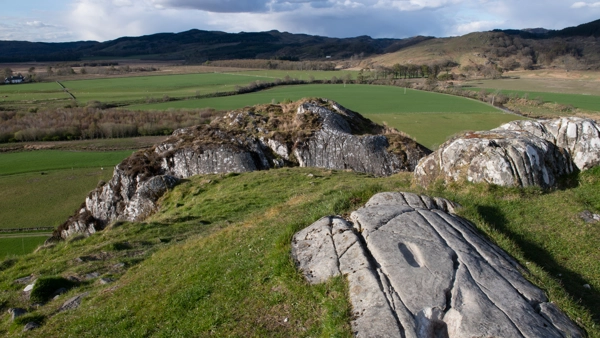
Dunadd Fort rises from an expanse of bog known as Moine Mhor (the ‘great moss’) at the southern end of Argyll’s Kilmartin Glen, one of Scotland’s most remarkable prehistoric landscapes.
It was an important royal power centre for Gaelic kings between 500 and 800 AD, and has been occupied for 2,000 years.
Look out for two human footprints carved into the rock at the top. It’s thought that these would have been used during inauguration ceremonies for new kings.
Dunadd Fort image gallery


Auchindoun Castle
If you’re up for a hearty, historic trip to the hills, look no further than spectacular Auchindoun Castle!
This lonely 15th-century stronghold can only be accessed by foot, via a path through the hills south of Dufftown. The romantic ruins and views overlooking the River Fiddich are well worth the walk, though.
Auchindoun Castle photo gallery


Muir o’Fauld Roman Signal Station
What have the Romans ever done for us? Well, amongst many other things, they’ve given us plenty of outdoor beauty spots to enjoy!
From places like Bar Hill and Croy Hill, there’s plenty of walks to be enjoyed along the route of the Antonine Wall, the Roman frontier which once stretched between the Forth and the Clyde.
One of our lesser known Roman sites is Muir o’Fauld Roman Signal Station. It’s accessed via an unassuming woodland footpath close to Trinity Gask in Perthshire. Muir o’Fauld dates to AD 79–80 and was a watchtower on the Gask Ridge Roman frontier.
Muir o'Fauld Roman Signal Station photo gallery


Dun Carloway Broch
Dun Carloway has been sitting on its perch on a rock on the Isle of Lewis since at least 200 AD.
A uniquely Scottish structure, it has seen use as a pottery kiln, a shelter for cattle raiders and a home for “a respectable looking family” over the centuries.
There’s no interior access at the moment due to conservation work, but the broch’s stunning location, with views towards Loch Roag and the Atlantic Ocean beyond, makes for a truly memorable walk.
Duncarloway Broch image gallery


Kilchurn Castle
Undoubtedly one of the most photograph-able castles in the land, Kilchurn Castle was the powerbase of the Campbells of Glenorchy since the mid-1400s.
Later on, the fortress on the banks of Loch Awe was converted into a barracks for around 200 men. It was eventually abandoned at the end of the 1700s, becoming the impossibly romantic ruin we see today.
If you fancy an Awe-some lochside walk, there’s exterior access to the castle.
Kilchurn Castle


Holyrood Park
If you’re looking for some green space to enjoy in the Capital, follow in the footsteps of generations of Edinburgh residents by heading to Holyrood Park.
It is thought that the crags and slopes of the Park have been used by humans since at least 5000 BC. Evidence of prehistoric agriculture and fortifications can still be seen today.
From the 1100s, Holyrood Park was closely linked with religion and royalty. Generations of Scottish monarchs starting with David I used it as hunting and pleasure grounds.
On a rocky outcrop above St Margaret’s Loch you can find the ruins of St Anthony’s Chapel, which was once closely associated with nearby Holyrood Abbey. Further up the path is the summit of that famous extinct volcano, Arthur’s Seat, and panoramic views across Edinburgh and beyond.
Holyrood Park photo gallery


The Peel Ring of Lumphanan
Tucked away beside the Aberdeenshire village of Lumphanan is the Peel Ring, the site of an early timber castle which was once surrounded by a moat.
The castle was once believed to have been the seat of Macbeth, but excavations later revealed it was built some 200 years after his death.
That hasn’t ended this grassy spot’s association with the famous King of Scotland, though. He is said to have been defeated and mortally wounded by the future Malcolm III at the Battle of Lumphanan in Aberdeenshire in 1057.
Macbeth’s Stone, just 300m from the Peel Ring supposedly marks the site where the king died. At Macbeth’s Well, he may have quenched his thirst before the final skirmish.
Peel Ring of Lumphanan photo gallery


Historic places in this feature
View all our sitesLoch Doon Castle
Trace the 11-sided stone curtain wall of a medieval castle that may originally have been built by Robert I (the Bruce) himself.

Kilmartin Glen: Dunadd Fort
Climb this spectacular rocky outcrop to see what was once a royal power centre of Gaelic kings.
Auchindoun Castle
Clamber to the bleak and beautiful Auchindoun Castle, built in the 1400s and now a lonely ruin.

Muir o'Fauld Roman Signal Station
Visit Muir o'Fauld Roman Signal Station, one of the best preserved elements of the Gask Ridge frontier, the earliest known Roman frontier system.

Dun Carloway
Discover the ruins of a uniquely Scottish site atop a mound of rock on the Isle of Lewis.

Kilchurn Castle
Look out over Loch Awe from the powerbase of the Campbells of Glenorchy and one of the most photographed castles in Scotland.
Grounds or exterior access only

Holyrood Park
Welcome to Holyrood Park, the breathtaking landscape at the heart of Edinburgh.
